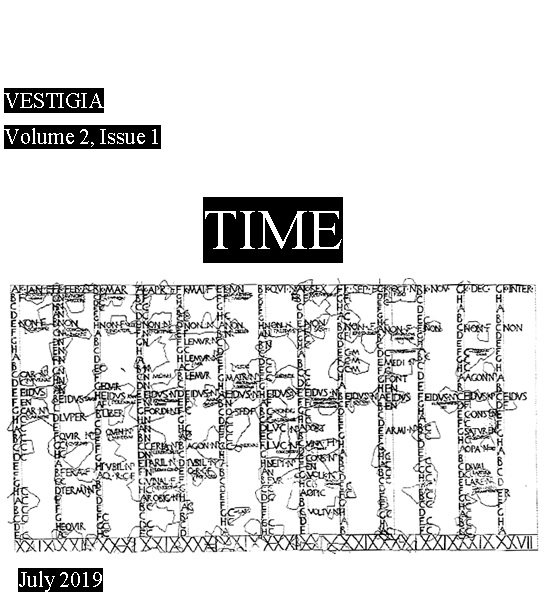
The cover shows the fragmentary Fasti Antiates Maiores (c. 60 BC) with the seventh and eighth months still named QVI (Quintilis) and Sextilis.
ARTICLES
Vestigia Volume 2, Issue 1, 2019, pages 7-13
From timelessness to otherness: the articulation of symbolic time in Jacques Lacan’s work
Vestigia Volume 2, Issue 1, 2019, pages 14-35
It is generally believed that to Lacan, the symbolic order exists in the field of language. It is the realm of synchronic difference between signifiers that determines the constitution of the subject. However, I argue in this article that a temporal dimension is also essential to Lacan’s theorisation of the symbolic order. Instead of being a static system, the symbolic order is rather a dynamic one in a process of constant movement. The articulation of the time of the symbolic order is made possible by Lacan’s critical examination of Freud’s idea of the timeless unconscious and the enlightenment of cybernetic theory. This temporal dimension, which I name ‘symbolic time’, cannot be assimilated into inner time consciousness or objective time measured by the clock or calendar. It confronts us from outside as a seemingly independent force that accounts for the unpredictable encounter between the subject and the Other.
Keywords: Cybernetics, Lacan, symbolic, time, timelessness
Vestigia, Volume 2, Issue 1, 2019, Pages 36-52
This article discusses the embodiment of time in therapy from two different perspectives. On the one hand, there is a vast focus in our society on values such as efficiency, logic and instrumentalism. Within this discourse, the time for psychotherapy is presumed to be calculable and measurable. From a Lacanian viewpoint, however, it is impossible to foresee a subject’s time for understanding in advance. Our study explored the contrast between these two discourses by interviewing psychoanalytic psychotherapists working within a time limited setting. We studied how they experienced working with a time limit and how it disagreed with their customary Lacanian way of working. Working time limited conflicted with their psychoanalytic frame and ethics on three different levels: the time limit had a restricting effect on the patients’ speech, patients’ expectations changed because of the time limit and finally therapists noticed that patients became alienated from their subjective time because of the predetermined time frame. This article demonstrates how inserting a time limit in a psychoanalytic therapy not only changes the patients’ and therapists’ sense of time, but also has severe consequences for other crucial aspects of a Lacanian psychotherapy, such as the transference, free association and free floating attention.
Key words: time limit, psychoanalysis, Lacan, psychoanalytic psychotherapy, managed care
The fixity of images and the perception of time
Vestigia, Volume 2, Issue 1, 2019, Pages 53-65
In this paper I will try to underline a specific feature of the internal and subjective perception of the flow of time. I am referring to the fixity quality that some mental images may acquire through some specific conditions. The issue will involve which traits may those fixed images have and the specific relations that they show with the flow of time. This reflection will bring us very close to some psychoanalytic concepts that previously other authors had described and on which they focused their attention. I will refer mainly to the Internal Objects of the British Psychoanalysis (Heinmann 1949), to the phantoms and to the Transitional Objects (Winnicott1953). Following this path, we will find some analogies and differences between fixed images and those psychoanalytic concepts. Subsequently, I will try to analyze and hypothesize a relationship between those fixed images and the subjective time perceived, therefore probably following the same direction set by Fachinelli E. in “La Freccia Ferma” (1992) when he draws attention on a “chronotype” (cronotipo) as a form of a subjective mental elaboration of time. Lastly, we will be able to analyze three different forms of fixed images, which are related to as many clinical conditions: psychosis, trauma and fetishism.
Sommario: In questo scritto si cercherà di evidenziare una caratteristica della percezione interna e soggettiva dello scorrere del tempo. Mi riferisco alla fissità che alcune immagini mentale, mediante alcuni procedimenti, possono acquisire. Ci si chiederà, dunque, quali caratteristiche possono avere queste immagini e quale è il loro rapporto con il fluire del tempo. Questa riflessione ci porterà molto vicino ad alcuni concetti psicoanalitici che in precedenza altri autori hanno descritto e sui quali hanno focalizzato la loro attenzione. In questo modo si troveranno delle analogie e delle differenze con questi concetti, mi riferirò prevalentemente agli oggetti interni della psicoanalisi britannica, ai fantasmi e agli oggetti transizionali. Successivamente la riflessione ci porterà ad analizzare ed ipotizzare quale possa essere il rapporto tra queste immagini fisse e il tempo soggettivo percepito, seguendo la linea tracciata da Fachinelli che ne “La freccia ferma” richiamava l’attenzione sulla cronotipia come elaborazione soggettiva temporale. Questo ci permetterà di analizzare tre diverse forme di immagini fisse, legate ad altrettante condizioni cliniche rilevanti: la psicosi, il trauma e il feticismo.
Résumé: Dans cet article, je vais essayer de souligner une caractéristique spécifique de la perception interne et subjective de la durée. Je fais référence à la qualité de fixité que certaines images mentales peuvent acquérir dans certaines conditions. La question portera sur les caractéristiques que peuvent avoir ces images fixes et sur les relations spécifiques qu’elles révèlent au fil du temps. Cette reflexion nous rapprochera de certains concepts psychanalytiques précédemment décrits par d’autres auteurs et sur lesquels ils se sont concentrés. Je me référerai principalement aux objets internes de la psychanalyse britannique (Heinmann 1949), aux fantômes et aux objets transitionnels (Winnicott 1953). Suivant ce chemin, nous trouverons des analogies et des différences entre les images fixes et ces concepts psychanalytiques. Par la suite, j’essaierai d’analyser et de considérer l’hypothèse d’une relation entre ces images fixes et le temps subjectif perçu, en suivant probablement la même direction que Fachinelli E. dans ‘La Freccia Ferma’ (1992) lorsqu’il attire l’attention sur un ‘chronotype’ (cronotipo) en tant que forme d’élaboration mentale subjective du temps. Enfin, nous pourrons analyser trois formes différentes d’images fixes liées à autant de conditions cliniques : psychose, trauma et fétichisme.
Abstracto: En este paoel yo tratarè de subrrayar una novedad especìfica de la percepciòn subjetiva en el flujo del tiempo. Me estoy refiriendo a la cualidad del arreglo de algunas imàgenes mentales que puedan adquirir a travès de condiciones especìficas. El asunto involucrarà cuàles tratos tendran esas posibles imágenes fijadas y tener sus relaciones especìficas a mostrarse en el flujo del tiempo. Esta reflexiòn nos traerà muy cerca de algunos conceptos psicoanalìticos que previamente algunos autores han descrito en los cuales han enfocado su atenciòn. Me referirè principalmente a los objetos internos del psicoanàlisis Britànico ( Heinmann 1949) a los fantasmas y los objetos transicionales ( Winnicott 1953). Siguiendo este camino, vamos a encontrar analogìas y diferencias entre imàgenes fijadas y esos conceptos psicoanalìticos. Subsecuentemente yo tratarè de analizar e hipotetizar una relaciòn entre esas imàgenes fijas y el tiempo subjetivo percibido ahì mismo probablemente siguiendo la misma direcciòn por Frachinelli E. en ” ” La fraccia ferma” (1992) Cuando el dibuja su atenciòn en el cronotipo ( cronotipo) como una forma subjetiva de elaboraciòn mental ďl tiempo. Por último seremos capaces de analizar tres formas diferentes de imàgenes fijadas, que estan relacionadas con muchas condiciones clìnicas: psicosis, trauma y fetichismo.
Vestigia, Volume 2, Issue 1, 2019, Pages 66-74
The concept of temporality in the process is examined from J. Canestri’s text with overlaps from F. Petrella’s text. This communication takes up the notions of synchronous causality and the diachronic dimension of the process. It also considers the elusive time in the analytic process from the concept introduced by Canestri on the theorizations of the analyst in the cure, theorizations that are the foundation of the process.
Key words: Time – Process – Synchronous / diachronous
Résumé. Le concept de temporalité dans le processus est examiné à partir du texte de J. Canestri avec des recoupements dans le texte de F. Petrella. Cette communication reprend les notions de causalité synchrone et de dimension diachronique du processus ainsi que celle de l’insaisissable du temps dans le processus analytique à partir de la notion introduite par Canestri sur les théorisations de l’analyste dans la cure, théorisations qui fondent le processus.
Mots clés: Temps – Processus – Synchronie/diachronie.
Sommario: Il concetto di temporalità nel processo analitico è esaminato a partire dal testo di J. Canestri con riferimenti al testo di F. Petrella. Questo scritto riprende sia le nozioni di causalità sincrona e di dimensione diacronica, sia quella di inafferrabilità del tempo nel processo analitico, a partire dal concetto introdotto da Canestri sulle teorizzazioni dell’analista nella cura, teorizzazioni che fondano il processo stesso.
Parole chiave: tempo, processo analitico, sincronia/diacronia.
Democracy and eternity in Spinoza
Vestigia, Volume 2, Issue 1, 2019, Pages 75-80
The time of our life flows. Spinoza clarifies that when our mind imagines, it perceives the existence of our body according to its duration. Yet each of us is part or gradus of the infinite and eternal productivity of God, sive Nature. To the extent that, in the Fifth Part of the Ethics, and denying the immortality of the soul, Spinoza states: in earthly and finite life, as grimed as it is splendid, we can experience eternity (sentimus, experimurque, nos aeternos esse). It may seem the privilege of a few wise individuals, but only in democratic practice, in the common life of the many, can such an experience be had.
Key words: Duration, eternity, potency, praxis, democracy
Résumé:Le temps de notre vie s’écoule. Spinoza clarifie que lorsque notre esprit imagine, il perçoit l’existence de notre corps en fonction de sa durée de vie. Pourtant, chacun de nous fait partie de l’infini et de l’éternelle créativite de Dieu, sive Nature. Dans la mesure où, dans la cinquième partie de l’éthique, et reniant l’immortalité de l’âme, Spinoza affirme: dans une vie terrestre et finie, aussi caricaturale que magnifique, nous pouvons expérimenter l’éternité (sentimus, experimurque, nos aeternos esse). Cela peut sembler être le privilège de quelques individus sages, mais ce n’est que sous un regime démocratique q’une telle expérience peut être vécue dans la vie quotidienne de plusieurs personnes.
Mots cles: Duree, éternite, puissance, praxis, democracie
Sommario: Il tempo della nostra vista scorre. Quando la nostra mente immagina, chiarisce Spinoza, percepisce l’esistenza del corpo secondo la durata. Eppure ciascuno di noi è parte o gradus dell’infinita ed eterna produttività di Dio, sive Natura. Tanto che, nella Quinta parte dell’Etica, e negando l’immortalità dell’anima, Spinoza afferma: nella vita terrena e finita, sporca quanto splendida, possiamo fare esperienza dell’eternità (sentimus, experimurque, nos aeternos esse). Potrebbe sembrare privilegio di pochi saggi, invece solo nella prassi democratica, nella vita comune dei molti, una tale esperienza può essere conquistata.
Parole chiave: Durata, eternità, potenza, prassi, democrazia
Abstracto: El tiempo de nuestra vida fluye. Spinoza aclara que cuando nuestra mente imagina, percibe la existencia de nuestro cuerpo de acuerdo con su duraciòn. Sin embargo, cada uno de nosotros es parte o gradus de la infinita y eterna productividad de Dios, Sive Nature. En la medida en que en la quinta parte de Las Eticas y negando la inmortalidad del alma Spinoza dice: en la vida terrenal y finita , tan sombrìa como esplèndida es, nosotros podemos experimentar eternidad ( Sentimus, experimurque, nos aeternos esse). Parece el privilegio de unos pocos individuos inteligentes. Pero no solo en la pràctica democràtica ,en la vida común de muchos, puede tal experiencia ser terrible.
Palabras Clave: Duraciòn, Eternidad, Potencia, Praxis, Democracia.
Vestigia, Volume 2, Issue 1, 2019, Pages 81-84
Vestigia, Volume 2, Issue 1, 2019, Pages 85-102
In this paper the author highlights some issues and complexities that arise when we try to treat the topic of time. In this regard, he focuses mainly on an exchange of views that happened between Albert Einstein and Henri Bergson in the second decade of 20th century at the end of a conference which was organised in honour of the physicist. In this way the author aims to underline the necessity of keeping in mind that the word ‘time’ can signify different things, and shows that this conceptual separation is required in order to gain clarity and complexity in different discourses. He focuses mainly on the issue of time for psychology.
Key words: Time, psychology, physics, perception and transformation.
Sommario: In questo scritto cercherò di evidenziare alcune problematiche e complessità che emergono quando si cerca di trattare il tema del tempo. Per farlo mi concentrerò prevalentemente su uno scambio di punti di vista avvenuto nel secondo decennio del novecento tra Henri Bergson e Albert Einstein al termine di un convegno organizzato in onore del fisico. Mi auguro in questo modo di evidenziare la necessità di tenere a mente che la parola tempo può significare diverse cose e cercherò di mostrare come questa separazione concettuale è necessaria in termini di chiarezza e complessità dei discorsi. Mi focalizzerò prevalentemente sulla questione del tempo per la psicologia.
Parole chiave: Tempo, psicologia, fisica, percezione e trasformazioni.
Vestigia, Volume 2, Issue 1, 2019, Pages 103-125
Within the framework of the dual instinct theory of S. Freud, this article examines the trauma of war throughout time, specifically while considering the notion of the defusion of instincts aiding the drives of death and self-destruction. The analysis is centered on both references of art and literature: first, the Guernica (1937) by Pablo Picasso, which in its universality, highlights certain images from the massacres of the Lebanese civil war (1975-1990) such as they have been described by veterans; second, the plot of Hiroshima mon amour (1959) by Marguerite Duras, serves to underline the timelessness of the unconscious as well as the activation of the life instincts, namely the sexual instincts, in an attempt to humanize the unthinkable trauma. Finally, the article concludes by exploring how the association of all these separate elements may contribute to the aftermath of trauma, the psychic temporality as well as to the construction of the individual and collective historicity.
Keywords: Defusion of instincts, war trauma, psychic temporality, timelessness of the unconscious, aftermath
Résumé: En se basant sur la théorie des pulsions de S. Freud, examinant notamment la désintrication pulsionnelle au service des pulsions de destruction et de mort, l’article se penche sur les traumas de guerres à l’épreuve du temps. L’art et la littérature y serviront de point d’appui : l’universalité de la toile de Guernica peinte par Pablo Picasso en 1937 permettra de mettre en exergue certaines images des massacres de la guerre civile libanaise (1975-1990) telles qu’elles ont été décrites par des anciens combattants; l’analyse de la trame de Hiroshima mon amour écrite par Marguerite Duras en 1959, mettra en évidence l’intemporalité de l’inconscient mais aussi l’activation des pulsions de vie- pulsions sexuelles dans une tentative d’humaniser l’impensable trauma. Nous examinerons enfin comment l’association de tous ces éléments épars servira dans l’après-coup, la temporalité psychique mais aussi la construction d’une historicité individuelle et collective.
Mots clefs: Désintrication pulsionnelle- traumas de guerre- temporalité psychique- inconscient intemporel- après-coup
Sommario: Basandosi sulla teoria pulsionale di S. Freud, esaminando soprattutto il disimpasto pulsionale al servizio delle pulsioni di distruzione e di morte, il testo si sofferma sui traumi di guerra alla prova del tempo. L’arte e la letteratura serviranno da punto di appoggio: l’universalità dell’opera di Guernica, dipinta da Pablo Picasso nel 1937, permetterà di mettere in esergo certe immagini relative ai massacri della guerra civile libanese (1975-1990), per come sono stati descritti da anziani combattenti; l’analisi della trama di Hiroshima mon amour, scritto da Marguerite Duras nel 1959, metterà in evidenza l’atemporalità dell’inconscio ma anche l’attivazione delle pulsioni di vita-pulsioni sessuali, nel tentative di umanizzare il trauma impensabile. Esamineremo, infine, come l’associazione di tutti questi elementi sparsi sarà al servizio, nell’après-coup, della temporalità psichica ma anche della costruzione di una storicità individuale e collettiva.
Parole chiave: disimpasto pulsionale, trauma di Guerra, temporalità psichica, inconscio atemporale, après-coup.
Vestigia, Volume 2, Issue 1, 2019, Pages 126-150
In this paper, I discuss a particular temporality specific to the psychoanalytic encounter: the time of re-living. I see this time in the frame of an eventful psychoanalysis, where the “event” under consideration is that of psychic fragmentation. In dialogue with Sándor Ferenczi, I disentangle various facets of the event of fragmentation and I argue that it consists in sets of violent temporal relations. Ferenczi’s ideas on time are a ‘graft’ on the Freudian Nachträglichkeit: they acknowledge this violence of temporal relations, where the times of some fragments attack, displace, or negate the times of other fragments. In what follows, I reflect on the event of survival, the event of being beside oneself, autoplastic events, including the emergence of the Orpha fragment of the psyche, and the event of neo-catharsis on the psychoanalytic couch. I also reflect on alienation understood as temporal relation. There is a violent internal plurality of the times of the subject, where the different psychic fragments “living” inside a different time create an overall effect of a-synchrony. The analyst’s complicated work is to engage in some form of dialogue with these psychic fragments.
Keywords: re-living, time, temporality, event, Sándor Ferenczi, Nachträglichkeit, repetition, violent temporal relations.
Résumé: Dans cet article, je discute une temporalité particulière, propre à la rencontre psychanalytique: le temps de la réviviscence. Je vois ce temps dans le cadre d’une psychanalyse chargée d’évènements, où ‘l’événement’ observé est celui de la fragmentation psychique. En dialogue avec Sándor Ferenczi, je démêle les différentes facettes de la fragmentation et je soutiens que cela consiste en une succession de violentes relations. Les idées de Ferenczi sur le temps sont greffées sur la Nachträglichkeit Freudienne: elles reconnaissent cette violence des relations successives, où les temps de certains fragments attaquent, déplacent ou annulent les temps d’autres fragments. Dans ce qui suit, je réfléchis sur l’événement de survie, l’événement d’être à côté de soi, les événements autoplastiques, y compris l’émergence du fragment Orpha de la psyché ainsi que l’avènement de la néo-catharsis sur le divan analytique. Je réfléchis aussi à l’aliénation comprise comme relation qui se déploie dans le temps. On constate une violente pluralité interne des temps du sujet où les différents fragments psychiques vivant dans différents temps créent un effet généralisé d’a-synchronie. Le travail complexe de l’analyste consiste à s’engager dans une forme de dialogue avec ces fragments psychiques.
Mots clés: réviviscence, temps, temporalité, événement, Sándor Ferenczi, Nachträglichkeit, répétition, succession de relation violentes.
Sommario: In questo testo viene discussa una forma particolare di temporalità, specifica dell’incontro psicoanalitico: il tempo del ri-vivere. Colloco questo tempo nell’ambito di una psicoanalisi dell’evento, in cui l’”evento” considerato è quello della frammentazione psichica. In dialogo con Sandor Ferenczi, estrapolo vari aspetti della frammentazione, che io sostengo consista in serie di violenti rapporti temporali. Le idee sul tempo di Ferenczi sono inserite sul concetto freudiano di Nachtraglichkeit: esse tengono conto di tale violenza dei rapporti temporali, dove i tempi di alcuni frammenti attaccano, spostano o negano i tempi di altri frammenti. Nel seguente lavoro, rifletto sui tempi della sopravvivenza, l’evento di essere accanto a se stessi, su eventi autoplastici incluso l’emergere del frammento Orpha della psiche, e l’evento di neo-catarsi che accade sul divano analitico. Rifletto anche sull’alienazione in quanto rapport temporale. C’è una pluralità interna violenta dei tempi del soggetto, dove differenti frammenti psichici che “vivono” in un tempo diverso, creano un effetto complessivo di a-sincronia. Il complesso lavoro dello psicoanalista è quello di ingaggiarsi in un dialogo con questi frammenti psichici.
Parole chiave: ri-vivere, tempo, temporalità, evento, Sandor Ferenczi, Nachtraglighkeit, ripetizione, violenza temporale, relazioni.
Abstracto: En este escrito yo discuto sobre una temporalidad en particular y que es específica del encuentro psicoanalìtico: El tiempo de re_viviendo. Yo veo que este tiempo es el marco de un psicoanàlisis de parte aguas, donde el “evento” bajo consideraciòn es el de la fragmentaciòn psìquica. En diâlogo con Sàndor Ferenczi yo desembrollo varias facetas del evento de fragmentaciòn y discuto que este consiste en escenarios de relaciones temporales violentas. Las ideas de Ferenczi sobre el tiempo, son un “gràfico” del del Nachträglichkeit Freudiano. Ellos reconocen que esta violencia de relaciones temporales, donde los tiempos del ataque de algunos fragmentos atacan, desplazan o nieganlos tiempos de otros fragmentos. En lo que sigue, yo reflejo en el evento de sobrevivencia, el evento de estar junto a uno mismo, eventos auto plàsticos, incluyendo la emergencia del fragmento Orpha de la psique y el evento de neo_ catarsis en el divan psicoanalìtico. Yo tambien reflejo en la alienaciòn entendida como una relaciòn temporal. Hay una pluralidad interna violenta de los tiempos del sujeto, donde los diferentes fragmentos psiquicos “viviendo” dentro de un tiempo diferente, crear un efecto sobre el todo de una sincronìa.El complicado trabajo del analista es comprometerse en alguna forma de diàlogo con estos fragmentos psìquicos.
Palabras clave: re_ viviendo, tiempo, temporalidad, evento Sàndor Ferenczi, Nachträliglichkeit, repeticiòn, relaciones temporales de violencia.
Vestigia, Volume 2, Issue 1, 2019, Pages 151-172
In a blazing assault on the foundations of enlightenment values and rationality, Lacan’s Kant avec Sade attempts to read D.A.F. de Sade, the infamous French Marquis, as the consummate Kantian and in doing so, uncover the structural logic (and inconsistencies) underpinning both the virgin philosopher of old Königsberg and the libertine novelist’s ethics. Published just 8 years after Immanuel Kant’s Critique of Practical Reason, Sade’s Philosophy in the Boudoir details the depraved acts inflicted by a band of libertines on their virtuous and beautiful victim Eugénie de Mistival, and is, Lacan argues, not just an extension of Kant’s ethics, but in fact its completion. Sade shows us the disturbing truth of Kantian ethics that Kant himself had failed to recognize or admit. For Kant the ultimate objective of the moral law is the realization of the supreme good, the point at which virtue and happiness coincide. But by renouncing all emotional factors as “pathological” in the moral realm, Kant paved the way for a system of ethics which exposed the true and hideous face of jouissance and its structuring as the other side of the law. Nearly 60 years later and in light of our increasingly technologically mediated relationships, the question of sexual enjoyment and ethics has become ever more problematized. As cultural fantasies about “robotic sex” draw closer to our grasp, we must ask what the future entails for these new configurations of sexuality and Artificial Intelligence. Lacan’s groundbreaking contribution to the ethical debate Kant avec Sade whilst well-used in the literature on psychoanalytic ethics, has yet to be employed in relation to the (female) robot and its significance in human relationships. As sex becomes further “technologized” we are forced to inquire after the structure of enjoyment that drives it.
This paper will attempt to imagine how a reading of Kant avec Sade alongside Rupert Sanders’ 2017 film Ghost in the Shell can decipher the foundations of a future ethics that will derive from relationships with forms of embodied Artificial Intelligence, given that the law and jouissance are for Lacan inexorably connected. Furthermore, Ghost in the Shell, reveals the Sadean universe residing inside the seemingly most innocuous fantasies of robot bodies that prevail in contemporary culture. As developers and research units seek to legislate for Artificial Intelligence and “Robot Ethics”, the other side of the law as human jouissance, comes conspicuously into view. If Sade’s libertines’ fantasies of a perpetual victim grow out of their fascination with the “second death”, the inescapable law of castration, how would the “immortality” of the female robot body, and potential for endless torment, feature as a mode of fantasy for the desires of the libertines? What kind of ethics can be built around the assumption of a subject who does not know castration and who, supposedly, cannot suffer? And is the “sex-robot” the Sadean ethical imperative incarnate? This reading crucially allows us to stage the mutual haunting of two diametrically opposed philosophers through the fantasy of the female robot as undead subject.
Vestigia, Volume 2, Issue 1, 2019, Pages 173-192
MISCELLANEOUS
Vestigia, Volume 2, Issue 1, 2019, Pages 193-221
REVIEWS
Vestigia, Volume 2, Issue 1, 2019, Page 222-225
Vestigia, Volume 2, Issue 1, 2019, Page 226-227
Vestigia, Volume 2, Issue 1, 2019, Page 228-231
Vestigia, Volume 2, Issue 1, 2019, Page 232-234
BULLETIN
Vestigia, Volume 2, Issue 1, 2019, Pages 235-295